
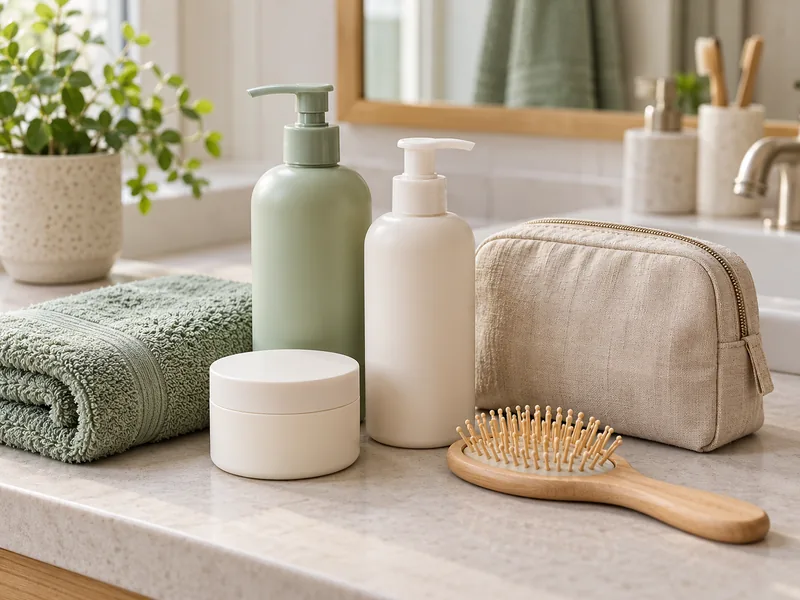
A toiletry bag should help you find your accessories and keep them stored conveniently. Size alone does not tell you whether it will suit you: small items can get lost in one large compartment, while too many pockets can make cleaning harder. This guide covers organization and accessories; it does not recommend any treatment or health product.
Take stock of an ordinary day
Lay out the items you actually use and separate those that stay at home from those you take with you. Measure the largest bottle and the longest accessory. Allow for the space taken up by caps and handles. For family use, several small, easy-to-identify bags may be more practical than one large bag, especially if family members use the bathroom at different times.
Look inside as well as outside
A wide opening makes a small item easier to find. Removable compartments sometimes let you change the layout, but check that they stay in place when you carry the bag. Look for photos showing the seams, corners and lining. A “water-resistant” label does not necessarily mean the bag will contain a leaking bottle; zippers and seams also need to be considered.
Plan for cleaning and drying
Read the care instructions for the bag and each accessory. Do not assume a synthetic lining is machine washable. Choose an arrangement that lets accessories dry according to their instructions before you put them away. Keep packaging and labels that help you identify the products. Putting something in a bag does not replace its stated storage requirements, especially for medication.
Match the bag to the trip
For a short visit, a soft bag may fit into luggage that is already full; for use at your destination, a shape that stays open may be more practical. If you are flying, check the current airline and security screening rules for your specific items. Do not buy a particular size based only on a “travel” claim. For any decision related to a health concern, ask a qualified professional for advice.
Rehearse packing before the trip
On a table, group only what you actually take. Compare the bag both open and closed; a flat pocket does not have the capacity of a deep compartment.
| Group | What to check on the bag |
|---|---|
| Largest container | Height including cap, opening and usable inside dimensions. |
| Small accessories | Find them without emptying the bag; a suitable closure. |
| Items that need to dry | Ability to remove accessories, clean corners and let them dry. |
Practise with your own clean, dry items. If packing requires squeezing a bottle, hiding a necessary label or enclosing a damp accessory, reconsider the arrangement.
Before you decide
Check off the points you have verified as you read. The site does not save this checklist.
General guidance, without product testing or personalized professional advice. Read about our method.